Margaret Driscoll of IBM write a great article on examples of various methods for blended learning:
Here's the list, see the article for details:
1. Put the assessment online.
2. Follow up with a community of practice.
3. Make reference materials available.
4. Deliver pre-work online.
5. Provide online office hours.
6. Use mentoring/coaching as a tool.
7. Provide job-aids.
8. Access experts.
9. Create a "lifeline".
10. Maximize e-mail and messaging.
I always say that if you teach online the same way you teach face-to-face, then you're not really teaching online. How does your style change when you tech online?
The Center for Academic Technology, part of the Learning Resources Division, at the University of the District of Columbia is the owner of this blog. The mission of The Center for Academic Technology (CAT) is to provide support and tools that enable pedagogical innovation to improve the educational experience of students. Our official website is: http://lrdudc.wrlc.org/cat/
Thursday, March 31, 2011
Methods for Blended Learning
Monday, March 28, 2011
Web 2.0 Tools and Student Engagement
Learning management systems have become ubiquitous in higher education. While some daring institutions employ open-source solution at little cost, most institutions are straddled with Microsoft-like monopolic marriage with their chosen vendor. Last week, I presented some techniques on Engaging Students Online to the Business School professors at the University of the District of Columbia. We discussed some tools available via Blackboard, but most of the applications were from the world of Web 2.0.
I recently stumbled upon Duke University's web 2.0 toolkit, a comprehensive site which introduces faculty to classroom appropriate tools.
The word 'introduces' is a bit troublesome as I've personally found it easier to transition tools I use personally into the classroom than vice versa. Think back to your first time trying to keystone the image on your LCD projector...I can tell you from having owned a projector, it's a lot easier when 30 kids aren't staring at you and asking why the picture is warped.
The following graphic attempts to provide some steps for getting involved with Web 2.0. Start slowly, make friends, and share your knowledge with others.
After viewing the Duke University site, why not choose a tool and see what it does? Technology is experiential... GO FOR IT!

I recently stumbled upon Duke University's web 2.0 toolkit, a comprehensive site which introduces faculty to classroom appropriate tools.
The word 'introduces' is a bit troublesome as I've personally found it easier to transition tools I use personally into the classroom than vice versa. Think back to your first time trying to keystone the image on your LCD projector...I can tell you from having owned a projector, it's a lot easier when 30 kids aren't staring at you and asking why the picture is warped.
The following graphic attempts to provide some steps for getting involved with Web 2.0. Start slowly, make friends, and share your knowledge with others.
Graphic by Andrew J Ryan -- don't steal!
After viewing the Duke University site, why not choose a tool and see what it does? Technology is experiential... GO FOR IT!
Thursday, March 24, 2011
Tool Availability in Blackboard
So you just left the department meeting and everyone is RAVING about the new features in Blackboard 9.1 (check here for tutorials). You immediately rush to http://udc.blackboard.com to login, but you don’t see the tools they were talking about:(
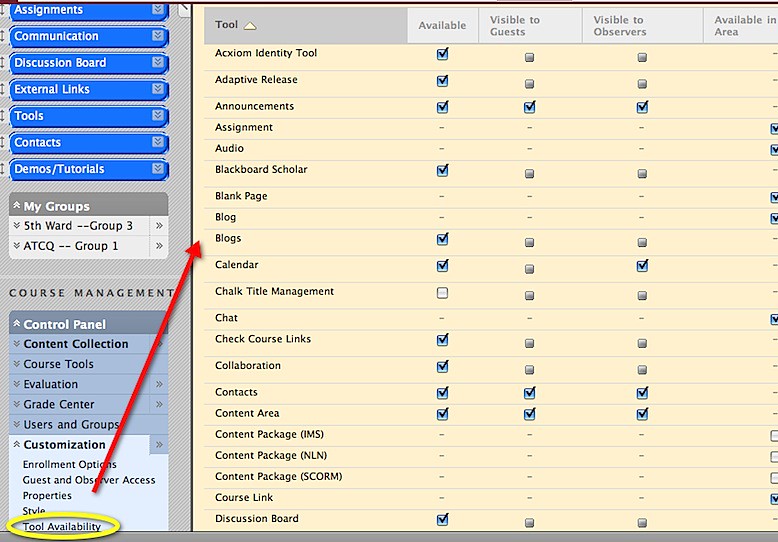
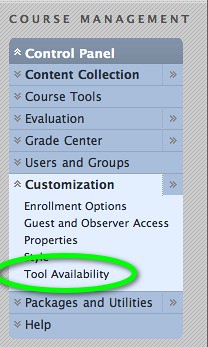
To remedy this, go to the *CUSTOMIZATION* menu under the CONTROL PANEL and select TOOL AVAILABILITY.
You will see the following page and will have the opportunity to select or deselect items.
To access the tools, click on *TOOLS* in your menu.
If you don't see a tool...go back back to TOOL AVAILABILITY. Be sure to SAVE your options before clicking on another menu item.
For more information on Blackboard tools, see the annotated User Manual.
To remedy this, go to the *CUSTOMIZATION* menu under the CONTROL PANEL and select TOOL AVAILABILITY.
You will see the following page and will have the opportunity to select or deselect items.
To access the tools, click on *TOOLS* in your menu.
If you don't see a tool...go back back to TOOL AVAILABILITY. Be sure to SAVE your options before clicking on another menu item.
For more information on Blackboard tools, see the annotated User Manual.
Labels:
blackboard,
communication,
pedagogy,
utilities
Subscribe to:
Posts (Atom)